
The Real Fire This Time: American War Crimes In The Iran War
A Published Author Looks At A New War

I am the author of an article published in Volume 146, Fall 1994 of the Military Law Review, entitled “No Fire This Time: False Accusations of America War Crimes In The Persian Gulf,” pp. 235–274. That article systematically rebutted allegations made by Former United States Attorney General Ramsey Clark alleging widespread warcrimes by the United States in the Persian Gulf. My article cited the relevant law of warfare and applied the facts to the law that had often been misstated by Ramsey Clark. I concluded that:
“The United States fought the Persian Gulf War with a concern for the laws of warfare that is unprecedented. Lawyers assisted tactical commanders in every phase of the operation and their advice altered methods and tactics . . . the issue of whether the United States committed war crimes in the Persian Gulf involves specific questions of law and fact that are generally ascertainable.” Id. pp. 273–74.
And so it is today. The rules have not really changed since I applied them to America’s conduct in 1994. The methodology then that acquitted America’s conduct can be applied today. However, America has changed, and the conclusions are not the same. As I state the international law standards in this article I will often quote directly from my published article from 1994.
Was Attacking Iran Legal? What The Law Says
Any statement of international law regarding when war is permissible must start with Article 2(4) of the United Nations Charter: “All Members shall refrain in their international relations from the threat or use of force against the territorial integrity or political independence of any state.” The same article also makes clear that: “All Members shall settle their international disputes by peaceful means in such a manner that international peace and security, and justice, are not endangered.”
While these provisions make clear that force is a last resort, the United Nations Charter establishes that force is justified in two circumstances. The first is when the United Nations Security Council authorizes force to advance world peace. Articles 41 and 42 work in tandem to assure that lesser means should first be attempted, but in the end the Security Council may call upon members to “take such action by air, sea, or land forces as may be necessary to maintain or restore international peace and security.”
The second circumstance where nations are justified in using force is in self defense when another member state is attacked. International law recognizes the self evident right of collective and self defense.
“Nothing in the present Charter shall impair the inherent right of individual or collective self-defence if an armed attack occurs against a Member of the United Nations.” United Nations Charter, Article 51.
The emphasized portion is of particular relevance, “if an armed attack occurs.” The threat of attack, the potential of attack, a maybe sort of might someday attack is not sufficient. An attack must occur to trigger the right of self defense against attack.
In 1994 I noted that both justifications applied. Iraq, without justification, launched a surprise attack on Kuwait. Kuwait and its allies (including the United States), were completely justified in responding in collective self defense under Article 51. Ramsey Clark did not even mention Article 51 when alleging our defense of Kuwait was illegal.
Similarly, United Nations Security Council Resolution 678, dated November 29, 1990, authorized member states:
“co-operating with the Government of Kuwait, unless Iraq on or before 15 January 1991 fully implements, as set forth in paragraph 1 above, the above-mentioned resolutions, to use all necessary means to uphold and implement resolution 660 (1990) and all subsequent relevant resolutions and to restore international peace and security in the area.”
Applying The Standards To America’s Attack On Iran
On February 28, 2026 the combined forces of the United States and Israel launched a surprise attack on Iran. The attack was preceded by no clear warnings or deadlines to conclude negotiations. This contrasts with the clear January 15th deadline set by the United Nations discussed above. In the First Persian Gulf War the United States and United Nations gave clear warnings as to when negotiations would end. Against Iran in 2026 we launched a sneak attack, in the midst of negotiations, that was more akin to Iraq’s sneak attack on Kuwait than our defensive response on behalf of Kuwait.
While the Trump Administration engaged in some vague saber rattling there was no clearly stated point beyond which negotiations would end. The United States participated in active negotiations at least through February 26th, with third parties to those negotiations reporting optimism a deal would be reached.
Iran appears to have called a meeting of its national leaders to discuss the American offer and status of negotiations. The United States and Israel exploited intelligence that pinpointed these meetings and initiated its attacks by bombing the meeting sites, killing many of Iran’s highest level leaders. Iran accused the United States of “betrayed diplomacy” and “bombing the negotiation table.” An argument can be made that the United States used perfidy to gain tactical advantage to assassinate the Iranian leadership.
Such perfidy is itself a violation of Article 37 of the 1977 Geneva Conventions:
“It is prohibited to kill, injure or capture an adversary by resort to perfidy. Acts inviting the confidence of an adversary to lead him to believe that he is entitled to, or is obliged to accord, protection under the rules of international law applicable in armed conflict, with intent to betray that confidence, shall constitute perfidy.”
Setting aside that potential war crime, the bottom line is that neither of the United Nations Charter’s justifications for force apply to the American attack. No Security Council Resolution authorized the attack and Iran did not attack either the United States or Israel prior to the attack.
That the Trump Administration’s justifications for this attack have been scattered, inconsistent and often self-contradictory only reinforces the flimsy basis for unilaterally initiating a major war with global economic and regional military impacts.
Conduct Of The War: The Principle of Discrimination
The principles of discrimination and proportionality are critical determinants of how war should be conducted. They are simple in statement, but complex in execution.
The principle of discrimination states that civilians, and civilian institutions, shall not be made the target of attack. The principle extends all the way to the Hague Conventions of 1907. Article 25 of the Hague Convention expressly states, “The attack or bombardment, by whatever means, of towns, villages, dwellings, or buildings which are undefended is prohibited.” Further:
“In sieges and bombardments all necessary steps must be taken to spare, as far as possible, buildings dedicated to religion, art, science, or charitable purposes, historic monuments, hospitals, and places where the sick and wounded are collected, provided they are not being used at the time for military purposes.” Hague Convention, Article 27.
Complicating the principle of discrimination is muddled law on the responsibilities of the attacker or defender in identifying protected areas. The Hague Conventions place responsibility on the defender to clearly mark areas subject to such protection. Subsequent international law, including the Geneva Conventions, place increasing responsibility on the attacker to make reasonable efforts to identify and avoid attacking civilians and non-combatant institutions.
Suffice it to say that in any event the law is clear that an attacker may not deliberately or knowingly target civilians or civilian institutions. However, even that apparently clear statement is subject to some ambiguity. Targets that are “dual use,” where the military gets some utility from it, are generally acceptable targets (subject to the principle of proportionality). Thus, attacking a nation’s power production and grid is generally acceptable because electricity has military uses.
A clear violation of this principle includes planned “double tap” strikes where the second attack on an otherwise legitimate target is conducted with the intent of targeting rescue workers and medical personnel attempting to assist injured people.
Conduct Of The War: The Principle of Proportionality
The principle of proportionality serves as a check on the dual use concept discussed above. Under this principle, incidental damage to property or civilian casualties cannot be disproportionate to the military advantage achieved by the attack. The classic example is that an attacker cannot destroy an entire village to kill a single enemy sniper.
To say the least, the boundary lines of proportionality are fuzzy. However, the doctrine of proportionality is not a fairness doctrine requiring one side to forsake advantages in firepower or technology. Disproportionate enemy casualties do not violate the principle of proportionality. That is, after all, the objective of combat. It is disproportionate civilian losses compared to the military advantage that violates this principle. Another commonly cited example is the allied firebombing of Dresden in World War II.
Possible Violations of the Principles of Discrimination and Proportionality
As the war progresses, Americans should be aware of these principles and of potential violations of them by any party. The rules apply to the Iranians, too, and arguably many of their own counterattacks in the region violate them. However, that would not excuse our own violations of international law, particularly since we started this war, and did so in clear violation of international law.
Evaluating some incidents conclusively is challenging because we don’t have all the details. All the same, I’d like to address some prominent news items.
Trump threatens to end the entire Iranian civilization. Today (April 7, 2026) President Trump declared that “A whole civilization will die tonight, never to be brought back again,” if his deadline for Iran to reopen the Strait of Hormuz is not met. In the history of modern warfare I am not aware of a national leader making a similar threat, never mind one who could actually carry it out. It certainly sounds like a threat to target both civilians, and civilian institutions, and to do so with no regard to proportionality or even with military objectives or targets in mind. The threat itself may not violate international law, but the statement should be viewed as a clear indicator of planning and intent for whatever happens next.
Attack On Iranian Elementary Girls School. In the early hours of the attack, the United States targeted the Shajareh Tayyebeh girls’ elementary school in Southern Iran with Tomahawk missiles. The attack killed nealry 200 civilians, most of whom were elementary-aged girls. There is some evidence the attack was a mistake caused by the use of out-of-date maps showing the school as part of Iranian Navy base. Among the problems with that defense, the school separated from the base over ten years ago, and Trump told ridiculous lies claiming the Iranians were responsible. If this was an honest mistake, it was a very stupid and bad one, and our president’s response to it was dishonest.
Karaj “double tap” Bridge Attack. On April 2, the United States attacked an under-construction bridge in Karaj, Iran. The bridge could not, at the time, have a military purpose, as it was not yet completed and still unusable. The United States justified the attack on grounds the future bridge was supposedly a “planned” supply route for missiles. To be kind, that’s rather a stretch, particularly since all of the 8 killed and nearly 100 injured were civilians. That sort-of-maybe future dual use seems weak when applying both the principles of discrimination and proportionality. The justification is also undermined by context, where Trump had just before promised to bomb Iran “back to the Stone Ages, where they belong.” Of equal concern are allegations that a second strike was timed for after rescuers arrived. As discussed above, that would be a clear violation of international law.
A Final Clear Violation: Hegseth’s “No Quarter” Declaration.
“We will keep pressing, keep pushing, keep advancing, no quarter, no mercy for our enemies.” — Secretary of Defense Pete Hegseth, March 13, 2026.
“No quarter” means a refusal to take prisoners. Merely declaring “no quarter” (as Hegseth clearly did) is a war crime. “It is especially forbidden to declare that no quarter will be given.” Hague Convention, Article 23(d).
In the conduct of this war, this statement is the most unquestionable war crime of them all. Further, this declaration suggests a contempt for all the laws of war. The statement suggests that when there might otherwise be doubt about the malice of American intentions, the United States should not be afforded the benefit of any doubt. The same is true for Trump’s threat to kill the entire Iranian civilization.
32 years ago I defended the United States against false allegations of war crimes. I wish I could do so today. Sadly, I cannot.
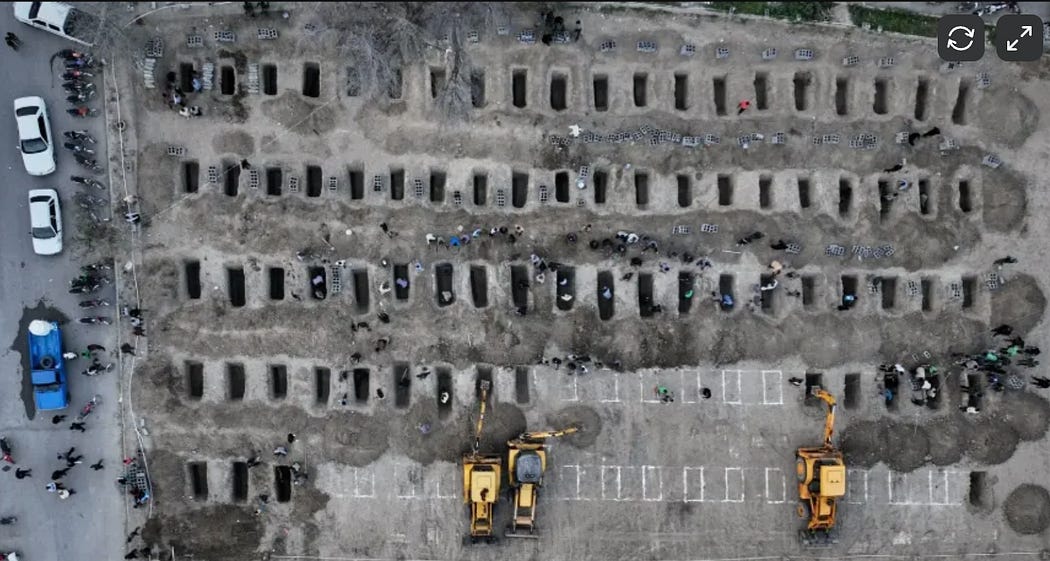
Graves at the elementary girls school. We did this.
Unfortunately we have a president who never believes laws should inhibit him from doing anything he wants. We have a Secretary of Defense who is too busy impressing Trump and MAGA with what a tough guy he is, to even care - and he has enough of a background to know better. Holding Putin responsible would be a good start in getting back to respecting international law. Whoever would be the prosector against Putin would have plenty to work with.