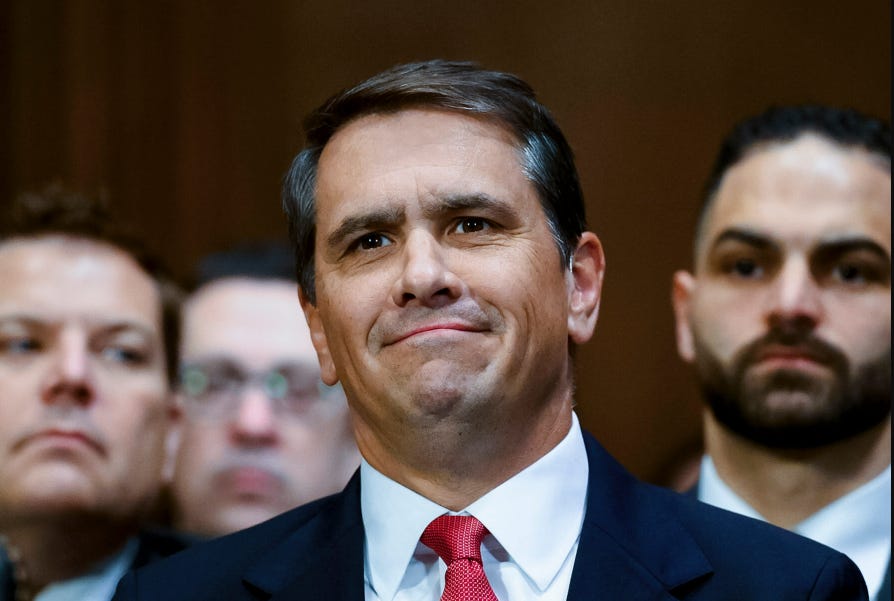
Trump's Attorney General Sanctioned And Referred For Bar Disciplinary Action

Today a federal judge imposed financial sanctions on, and referred to the New York State Bar for disciplinary action, Trump’s Acting Attorney General and nominee for Attorney General of the United States, Todd Blanche. The judge found that Todd Blanche (and others) filed a bad faith lawsuit, where Trump effectively sued himself, and then dismissed the case with his $1.776 billion slush fund settlement, “as a means of conferring legitimacy upon a course of action that they were unwilling to subject to judicial review.”
You can read the decision HERE.
At the heart of the judge’s decision was that the lawsuit was not even a legitimate legal action between genuinely adverse parties because Donald Trump exercised complete control over both of the supposed “parties.” Trump sued his own IRS for what his own IRS did.
In 2019 (while Trump was President and his IRS was run by his appointed commissioner) a worker in a company contracted by Trump’s IRS illegally leaked Trump’s tax returns. The Biden Administration prosecuted that employee and he remains in jail having been sentenced to five years in prison.
When Trump came to office he sued his own IRS seeking $10 billion of your tax dollars in compensation. Trump then orchestrated a settlement with himself and his IRS creating a $1.776 billion slush fund to compensate his friends that he felt were harmed by a “weaponized DOJ” under Biden. The IRS also agreed to drop all investigations of Trump’s taxes and to not investigate even potential violations with all that immunity extending to his family and his “affiliates.”
Here are some, though not all of the reasons, the judge found the lawsuit to been filed in bad faith.
The obvious flaw of a lack of legitimate adverse parties. Even Trump talked openly about how he had sued himself.
The quick dismissal of the case as soon as the court on its own inquired as to the problem of a lack of legitimate parties and ordered the DOJ to respond to that concern.
Under longstanding court precedent the IRS could not be sued for the misconduct of employees of contractors.
The lawsuit was filed months after the statute of limitations had expired.
The lawsuit demanded $10 billion when the statute limited the award to $1,000 per incident.
The settlement’s immunity provision, giving Trump, his entire family, and “affiliates” a free pass to tax fraud, clearly violates federal law.
As to that last point, the judge noted the agreement violated 26 U.S.C. § 7217 which states:
“It shall be unlawful for any applicable person to request, directly or indirectly, any officer or employee of the Internal Revenue Service to conduct or terminate an audit or other investigation of any particular taxpayer with respect to the tax liability of such taxpayer.”
Thus, Trump’s control over both litigants was so profound that the party he supposedly sued was willing to break the law on his order.
The judge also noted that the immunity provision also potentially violated the emoluments clause of Article II, Section 1, Clause 7 of the Constitution because it is a form of additional compensation (in effective tax relief) granted while Trump is office.
Here is the key paragraph from the decision:
“The Parties used the existence of federal litigation as a means of conferring legitimacy upon a course of action that they were unwilling to subject to judicial review. The context of the ‘settlement,’ the relationships of the people involved in negotiating and approving it, the ethical implications of their conduct, and the Parties’ swift efforts to dismiss this case after the Court raised fundamental jurisdictional questions all support his conclusion. Accordingly, the Court expressly finds that Plaintiffs acted in bad faith.”
Trump’s acting Attorney General, and wannabe Attorney General, and other attorneys, are referred by the court to their respective state bars for disciplinary action. In addition the court imposes monetary sanctions where these attorneys will be required pay for the legal services of amici counsel appointed by the court and the 35 former federal judges whose briefing initiated the court’s review.
The United States could find itself with an Attorney General whose license to practice law has been suspended. This will surely make for some salty questions during Todd Blanche’s confirmation hearings later this week. His confirmation was already viewed as hanging by a thread, that thread just got a strong tug.
All in all, Blanche should be looking less smug today.